All the growth questions my friends texted me last week
Call me maybe?

I’m Sam Richard, CRO at ngrok and former VP of Growth at OpenView where I got the pleasure of working with lots of great DevFirst companies on tough growth problems like pricing and packaging, metrics, and positioning.
I’m a serial connector, which means if I’m interested in something you’re working on I WILL dm you and become your friend. In fact, this is how I met Francesca. As a result of my extracurricular activities, I often feel like my iMessage is a clearinghouse for growth convos (and SaaS gossip). I figure why not reuse my friendships and monetize them as content, right? Just kidding, we know I’m not getting paid for this. Nevertheless, this week I discussed how to get trials to convert “better” and put some more in the bank for later issues of this newsletter. Stay tuned.
Names and companies have been hidden to protect the innocent.
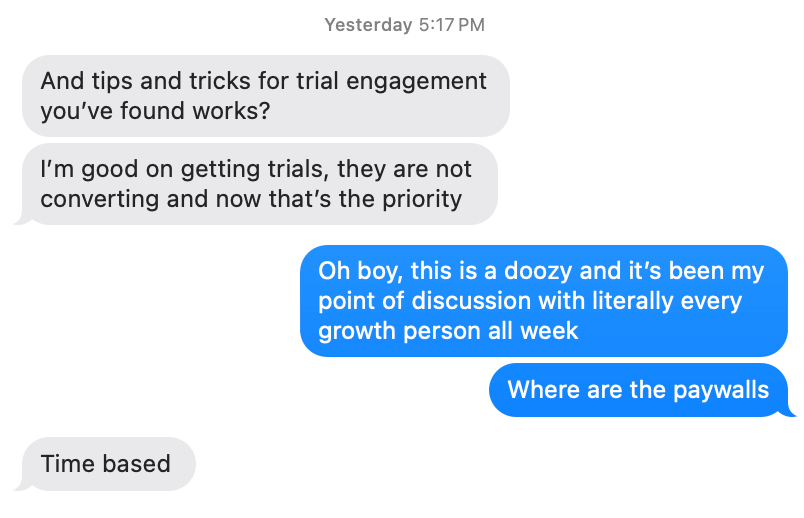
“We’re great at getting trials… but they’re not converting”
One friend reached out with a very specific (and very common) trial conversion problem.
The context: The current setup they described:
The product is seat-based and a tops-down purchase, and this is kind of a PLG motion inside of it. This PLG motion is new and my texting friend is leading it.
They only run trials for cross-sell / upsell. This means that they run them existing customers who already have a credit card on file.
A trial start signals something beyond high intent for a prospect, something akin to “opportunity created” for their internal teams.
14-day uncapped trial (they recently shortened it from longer)
They’re generating plenty of trial starts
But a lot of those trials aren’t converting and the users aren’t engaging with sales either
The trial is OF COURSE an AI feature
My pushback:
What should we actually count here as a “Trial Start”?
A self-serve attempt to use a new product is truly not the same as a new opportunity from a sales-led world. I suggested not only a handraise but some real usage of the new AI product should count as a trial start. If we cut the data that way does the trial conversion look better?
Change Trial Start signal to a handraise vs. an opportunity creation
This thread is a great example of a very specific growth trap: PLG high trial volume + low conversion can be really frustrating at a sales-led org that expects product-led users to be qualified sales leads like marketing feeds them. These are not marketing leads! The product trial should have its own criteria for sales engagement. These often fall into two categories
Product data: Engagement metrics like usage. Some companies also use antipatterns as outreach signals. For example, if a user gets stuck or runs into an expensive error, get someone to reach out and offer help.
Firmographic and User data: Identify ICP accounts and titles qualify those for sales outreach. This is incredibly easy to set up these days thanks to tools like Clay.
Be the Human In the Loop: Ask them what they need?
This friend needs to be more aggressive in a few ways:
Product outreach: This is a new product. The product manager who created it and is owning it absolutely needs to be paired with this team to understand what is and is not working to quickly iterate alongside the team. Without that, GTM is lipstick on a pig. They need to be connecting with these prospective users or doing actual user interviews too.
Driving trial conversion: For example, I’d try reaching out to people who requested the trial but aren’t using the product and telling them the trial will be turned off if they don’t start engaging, and that they can get it back by reaching out again. (This is sometimes the nudge you need!)
Product Positioning (AKA not everything needs to be AI)
Very few folks were interacting in this “trial.” The audience for this trial is back office ops folks. One hypothesis that I threw out is that the product is an AI plastered textbox that required loads of imagination to use. Does this persona like to type their wishes and desires into empty boxes? Is this persona a bit scared of AI? If these things are true, I suggested that they should experiment with a less “AI-forward” approach and instead come up with a few templated asks for the trailers to choose from in order to drive an “aha” moment.
Right Message, Right person, Right time
Many of my growth suggestions included emails triggered off of a user’s action in inaction. My texting friend mentioned a broader comms fatigue problem: sales is already very aggressive with outreach, and marketing had been sending so many emails that they had to pull back to avoid burning out customers (and almost burning their sending domain).
I recommended pulling back on that but we all know how sales can be.
In my experience, the fewer recipients of an email in a workflow, the higher the open, clickthrough, and opportunity rate. The days of spray and pray are long gone. At ngrok, we target our emails to be focused on helping a person through a more friction-filled part of the journey like an error message, or helping them discover a feature that’s aligned to their use case.
Stuck on a growth question? Text us.
That’s it for this week’s batch. If you’ve got a gnarly growth question you’ve been texting your friends about, send it my way — I might feature it next time.
Gotta watch what I say in dms now 😆
While reading your take, I kept coming back to one question: what's the actual user experience that leads to trial activation? I remember using HubSpot and activating a trial without even realizing it was a separate feature. I'd click some action button, and a balloon would pop up saying "trial activated." That generated a ton of anxiety. How much does it cost to run? Is it just for me, or the whole team? Will it cancel itself, or do I need to manually cancel it?
And if you're an IC rather than a manager, there's another layer: would my manager be okay with the fact that I activated something?
So I'd add 'Is there a clear description of the rules under which I activated the trial?' to the "what counts as a trial start" framework.