Don't Lose Your Aura
Can we keep our creations authentic in the age of AI?

“How do we look at a world where the incentives are so anti human and how do we live with it? And where do we hold our ground?” Jia Tolentino
The world demands productivity and perfection. The post-englightenment age requires us to be striving for more, better, and faster. We’ve achieved so much through this directive: surpluses of everything, modern medicine, needs and demands that can be attended to in hours or less. With AI, creation is cheaper than ever before, and my biggest fear is we forget the struggle and work that goes into creating beauty. I have written about my usage of AI in the past. There are many systems and workflows I have built to accelerate my effectiveness. But one thing I cannot do is pretend that AI can create art.
I know I am not alone in my fears. In the context of my day-to-day work, I know that Brand is a critical asset for B2B businesses. Brands require human connection, which is impossible to create with generative AI, technology which has never taken a breath, has never loved, had never experienced pain. It’s telling that brand teams are now hiring or promoting leaders into role titled “Head of Storytelling” (Rippling), and “Head of Narratives” (Langchain).
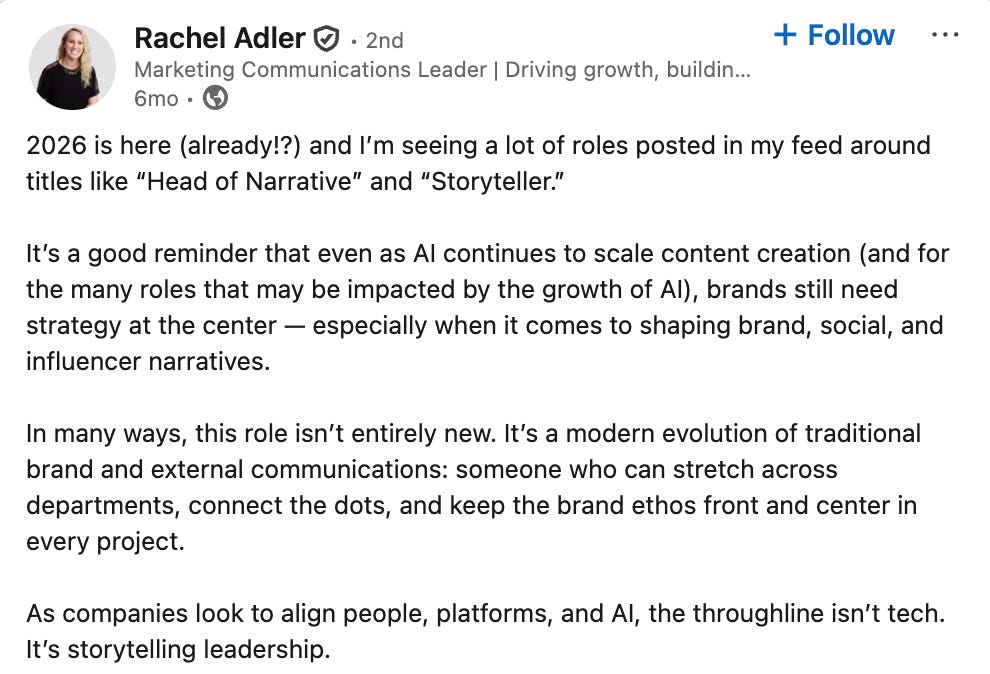
They’re no longer looking for folks to run “Content”. Content signals Context which signals AI, and performance-driven results. Storytelling is a two-way experience, a practice that relies on ritual.
My take: Marketing is going to evolve and the best marketers are going to focus on maintaining the ritual of artistic practice.
On the Evolution of Artistic Practice
With the advent of photography, painting had to evolve to become more conceptual. Fine art was focused on the ideas and feeling it could emote rather than the technique. Materials, their sources, the craft of finding and manipulating them, became a story worth telling.
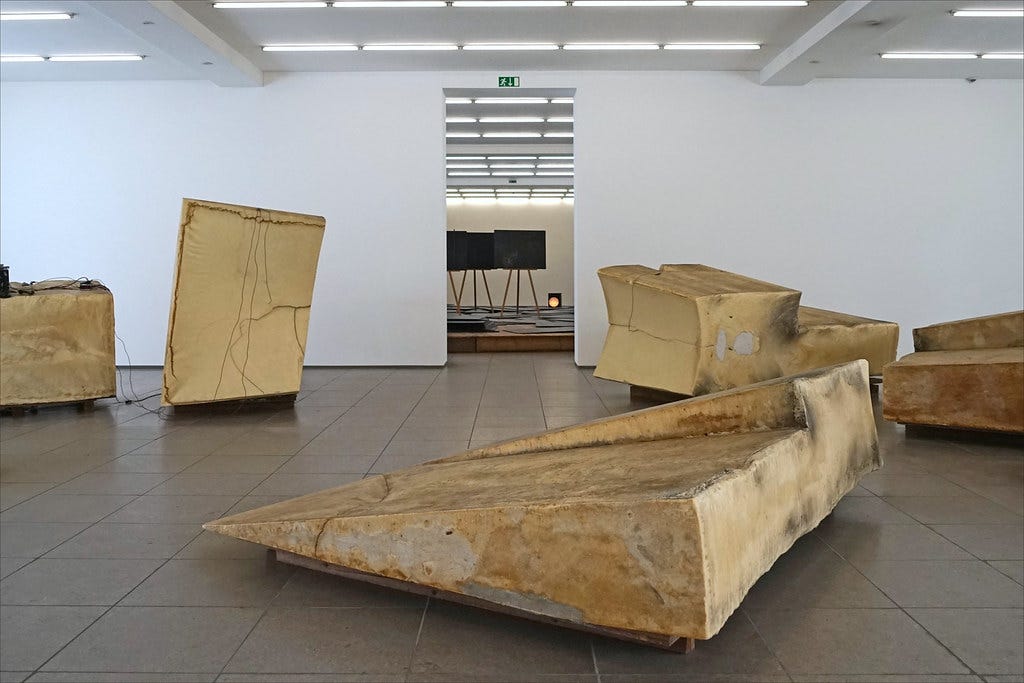
One of my favorite pieces that is representative of this change is Tallow, a set of sculptures by Joseph Beuys, a German sculptor from the 70’s, and it’s literally a set of blocks made out of beef tallow. Tallow melts in certain conditions, so this piece transforms in different environments.
Beuys told a fable along with this piece: when his plane crashed during World War II, his rescuers saved him by rolling him in Tallow.
This story is not true, but it doesn’t really matter, does it? That’s what art is. It’s a series of rituals and stories that push us to relate to the world.
As technology changed, we found a new way to represent authenticity. We found a new way to tell others how and why we felt.
I think we are in the early phases of this with AI and our art. Many of us have felt the anger and frustration of reading words written by a machine. Like nails on a chalkboard, we cringe as we scroll past LinkedIn and Substack posts written with the support of an LLM. I think we’re in the painful, congestive part of the cycle where many people have been given access to this wildly popular technology and are trying to figure out its edge.
I think the part that makes us cringe is using it to be someone they’ve always wanted to be! But that’s the problem. By trying to fulfill their purpose, they’ve alienated themselves from their authenticity.
They’ve started chipping away at their aura.
What is Aura?
Walter Benjamin’s seminal work “The Work of Art in the Age of Mechanical Reproduction” — which is not referenced nearly enough in discussions on AI and creativity — discusses the nature and purpose of art once it can be created or assisted by technology. He was living in Germany during the rise of the Third Reich, where film was being used to support a Fascist agenda. His concern was that the ability to reproduce art at mass scale can slowly remove the authenticity of a piece.
Even the most perfect reproduction of a work of art is lacking in one element: its presence in time and space, its unique existence at the place where it happens to be. This unique existence of the work of art determined the history to which it was subject throughout the time of its existence
Walter Benjamin
I believe these observations are crucial for our time, because this is the reason so many of us dislike reading AI-authored content. It sounds like nothing because it has no human experience!
By introducing technology that helps us mass produce content, we’re taking the art away from its original source, the aura. This essay stuck with me when I first read it in my — cringe — my undergraduate seminar, “Marx and Marxism”. This essay builds on Marx’s idea that alienating a person from their means of production is a core tenant of the human experience under captialism, and in the case of art, alienation of creation through technology slowly moves a person away from their authentic self. As humans move away from the creation and consumption of art with aura, they become less capable of communicating their core, authentic feelings.
History has shown us that there is art in photography. There is an art to capturing a scene and a feeling, and a certain genius has emerged from it. But it is not the same as the human experience of appreciating beauty without a lens.
If, while resting on a summer afternoon, you follow with your eyes a mountain range on the horizon or a branch which casts its shadow over you, you experience the aura of those mountains, of that branch.…the desire of contemporary masses to bring things ‘closer’ spatially and humanly, which is just as ardent as their bent toward overcoming the uniqueness of every reality by accepting its reproduction. Every day the urge grows stronger to get hold of an object at very close range by way of its likeness, its reproduction.
Walter Benjamin
And some compelling AI art has emerged as well — one example is Sheila Heti’s pieces in the New Yorker where she converses with a bot of her creation, Alice. There’s likely dozens more examples like this. But one thing that we can all agree on, AI writing sounds odd. It doesn’t feel good to read it. Substack even started tracking whether essays were written with AI — because 1, we hate reading them and 2, we don’t want to pay for AI-generated garbage.
The common thread? We believe that human perspective is an essential ingredient of culture, and this will be true no matter how powerful AI becomes.
Substack On Substack, How writers are reacting to Substack’s AI transparency tools
What I love reading is your voice. By you I mean the Royal you. I appreciate sloppy and imperfect writing. I love writing that has personality. That leaps. It’s one of the reasons I love reading Substack. I am discovering so many talented writers who have never had a career as a writer, but who introduce me to their lives, thoughts and ideas. It’s one of the reasons I started writing on Substack myself. I wanted to flex my creative muscles and connect with other people.
How to Maintain Your Aura
I thought about my aura a lot when I started using AI more frequently at work. Or specifically, how I could continue to build on my cognitive strengths while automating so much of my work. The way I use AI is for operations and orchestration, but I also use AI to take and summarize meeting notes, write Slack messages or construct processes. I am by no means an expert, but ere’s some practices I’ve found helpful to keeping myself creating my own work, and refining my own voice.
Create
In my opinion, the most radical thing we can do these days is create. This can mean knitting – which I’ve learned is Art x Math – or writing a poem. I’ve begun The Artist’s Way, a popular (and effective) 12-step program for re-igniting creativity, multiple times and never finished. But one of the practices find their way into my rituals: Morning Pages. In the custom of “get the frog out of your throat”, Morning Pages devotees will, upon waking in the morning, and before they look at their phones, write three pages of whatever comes to mind in their journal.
These are private thoughts, and private words. You’re not meant to show this to anyone, making it very non-judgemental practice. Either you power through or you don’t!
I like Oliver Burkeman’s perspective on Morning Pages:
Since the only fixed demand is that you fill three pages, Morning Pages demonstrates the principle that quality is often a function of quantity: there’s no time or incentive to judge each idea, to get it right before getting it down, and the result is that ideas flow more freely, unimpeded by the clenched grip of perfectionism. There are far more of them, and sometimes a few of them are good.
This is a very difficult practice for me to stick to as a mom of a young child and two dogs, but I do it when I can. When I can’t, I just wait until after daycare drop off, or whenever I can get a break. At first it’s hard to write three full pages, but eventually it comes out very easily. It’s very similar to an endurance sport. Writing three pages a morning requires and builds creative endurance.
Attribute When Necessary
If AI does any content-creation on my behalf, I attribute it to AI. I do this for fear that I might get caught, but also because I don’t want anyone to think I wrote that! AI is great at some things and not good at others. I recently had to map out processes that were the result of many conversations, interviews and feedback loops. The final document was authored by me, but AI was much better at summarizing and generating steps based on the hours of content I had recorded. I gave Claude the credit.
How do you keep up a ritual of creation in the age of AI?