The Campaign Flywheel
Marketers, here's how we find our way back to the customer

Marketing campaigns are aligned to business objectives: driving revenue, acquiring customers, driving awareness. But their latent function is a customer insight. I think as marketers, we are often so obsessed with the end goals of our programs, pleasing sales and the board that we veer away from the reason we were here in the first place: our customer.
A wise man, Brian Kotlyar, VP of Marketing at Hightouch, gave me excellent advice a few years ago: be the expert on your customer. As a marketer it is your job to understand the customers jobs to be done, their pains, their fears and how to reach them! On top of that, it’s a excellent way to build credibility with Sales and Product. I’ve seen many marketing teams assume product marketing is the only team that should understand the customer, an unfortunate outcome of extreme specialization in growing organizations.
But with AI tooling on our side and the right data we have the ability to distill more customer insights more frequently and turn our marketing programs into flywheels: fueling the engine with customer insights to increase reach.
Brian used recordings of customer and prospect calls in Gong as his primary resource to stay informed on the customer. Now, we don’t need to watch 20 Gong calls, we can summarize a huge number of transcripts. In my experience, LLMs are excellent at organizing this type of content into themes. We have MCPs for a number of our sales enablement, productivity and forecasting tools, including Gong and Glean, that give us deep understanding of the customer journey and better insight into the language customers are using.
The Campaign Flywheel
You run a Campaign with the goal of acquiring 20 new customers each month. Let’s say you acquire 25 customers in a month. Exceptional work! You are driving 25% more customers than you had originally planned. That’s the first value of running this campaign. But the customer insight around why this campaign is so powerful is the second value. This is best expressed using the sociological framework of manifest and latent functions.
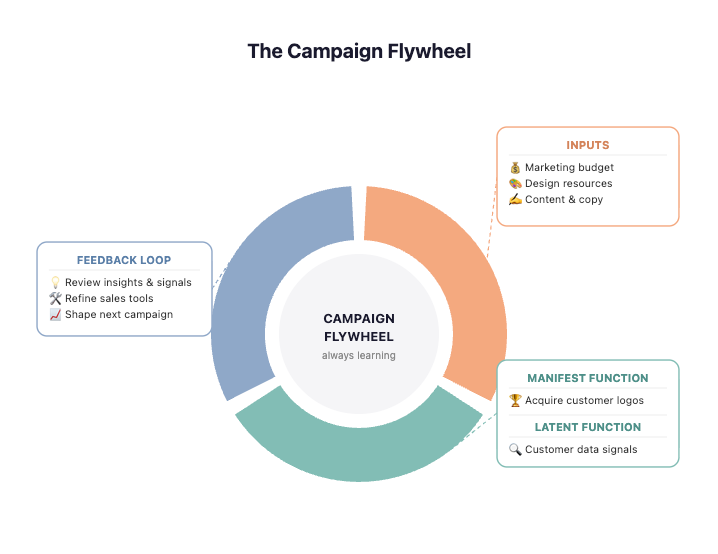
Your campaigns now have two jobs. The manifest functions are the outcomes we expect, the intended outcomes. The latent functions are the unintended outcomes. With the Campaign Flywheel, you deploy marketing dollars, design resources, content and execution budget. Your manifest function is acquiring those customer logos. The latent function of this are the customer insights you capture. While you run the campaign, you can review customer data signals, those sales tools we referenced above and capture those insights to inform your next campaign.
Analyzing Customer Insights
My teammate, Mary Alati, did this exact exercise for our Webinar program. We’re in the middle of Q2 and I wanted to understand how our overall programs are performing and what we could learn. Specifically, I wanted to understand why these prospects were looking to buy right now. She used our Omni MCP and hooked Claude into Glean to build the analysis.
New Hire Triggers
What we saw: One of our evergreen campaigns has gotten very good at acquiring teams new to dbt. We’ve recognized there’s a theme: when a new data leader comes in, they often want to modernize the data stack and dbt sits alongside Cloud Data Warehouses as the first things they invest in.
What we learned: This shouldn’t be news, these external triggers are sometimes the strongest indicator of buying intent and new leaders will often make purchase new software in their first 100 days to drive new strategy and execute quick wins. But, we hadn’t thought of it yet. This was the signal to get something kicked off!
What we’re doing: We’re taking this insight into the next iteration: using Clay to target job switchers of this persona with content about dbt.
The mAIn event
What we saw: We have a ton of folks engaging with our AI content — some from new personas! — but when it came to the deal cycle, it seems like our prospects are early in the AI maturity curve and are engaging with our content to see what great looks like. But implementation is a far way out.
What we learned: AI is obviously a hot topic and has high ROI, but teams are much earlier in the adoption process than we anticipated.
What we’re doing: Investing in some content that map to earlier in the AI maturity curve to capture more of that market.
Sharing the wealth
We’ve shared this project with our peers in Revenue Marketing to help them see the importance of incorporating customer insight into their campaign proposals. It’s a shared skill in Claude CoWork that anyone can pick up at dbt.
Your end users are the ones that matter, and in a less “woo woo” way, your customer knows more about how their organization adopts and purchases software than you do. our customers are always telling us what they think. Listening can be one of the most effective tools for we can improving your programs.
How are you using customer insights to power your marketing campaigns? How do you keep your marketers in touch with the needs of the customer? Share your best practices and let’s start the conversation.